


Key Takeaways
- 3D-guided dental implants and orthodontics can be combined to straighten and replace teeth in one comprehensive treatment plan, especially for complex smiles.
- Treatment sequencing matters: In most cases, orthodontics comes first to create proper space and alignment; in others, implants are placed first or simultaneously, depending on your unique needs.
- Toothworks of Bakersfield offers multidisciplinary care under one roof, using advanced 3D imaging, guided surgery, and microscopic tools to deliver accurate, natural-looking results.
- Titanium implants integrate with your jawbone to form a stable foundation that won’t shift during or after orthodontic treatment, making them ideal anchor points for complex cases.
When Missing and Crooked Teeth Require a Combined Solution
If you’re living with both missing teeth and misalignment—gaps from extractions, crowding that’s worsened over time, or a bite that’s never felt quite right—you’ve probably wondered whether braces or dental implants should come first. The short answer: it depends on your specific smile, and the best outcomes often come from planning both treatments together from the start.
At Toothworks of Bakersfield, we see this scenario frequently. Adult patients and older teens come to us with complex smiles that can’t be solved by orthodontics alone or by implants alone. They need a coordinated, multidisciplinary approach—one that sequences tooth movement and implant placement in the right order, using 3D-guided technology to ensure precision at every step.
This matters because the treatment order affects long-term stability, function, and aesthetics. Move teeth into the wrong positions, and you may not have room for an implant later. Place an implant too early, and it can block necessary tooth movement. But when a skilled team plans both together, you get a roadmap to the smile of your dreams—straight, complete, and built to last.
In this guide, we’ll walk you through how dental implants and orthodontics work together, when to do which treatment first, what 3D-guided placement means for your safety and results, and what to expect when you choose a Bakersfield practice that handles complex cases in one location.
How Dental Implants and Orthodontics Work Together
Dental implants and braces (or clear aligners) serve different purposes, but they’re highly complementary when planned as part of a full-smile makeover.
Orthodontics moves your natural teeth into ideal positions—correcting crowding, closing gaps, aligning your bite, and creating the space needed for future restorations. Braces or aligners apply gentle, controlled pressure to shift teeth through the bone over several months or years.
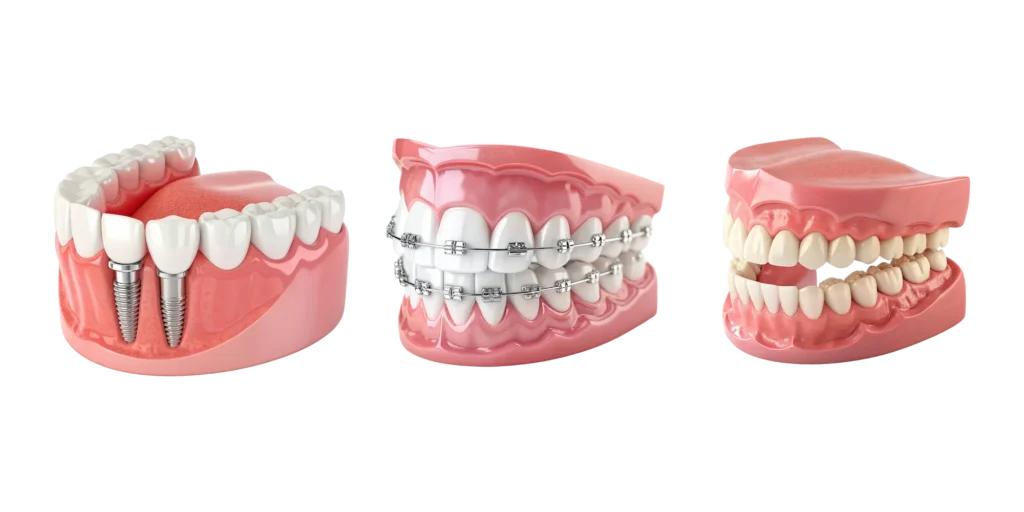
Dental implants replace missing teeth permanently. A titanium post is surgically placed into your jawbone, where it integrates with the bone tissue over 3–6 months (a process called osseointegration). Once healed, a custom crown is attached, giving you a tooth that looks, feels, and functions like a natural one.
Here’s the critical distinction: once an implant is placed, it becomes part of your jawbone and cannot be moved by braces. Natural teeth have a ligament around the root that allows them to shift under orthodontic pressure. Implants do not. They’re anchored in place.
That means timing and positioning are everything. If an implant is placed in the wrong spot—or placed before your teeth are properly aligned—it can block the movements your orthodontist needs to make later. Conversely, if you finish braces and then place an implant in a poorly planned location, you may end up with an unnatural smile line or bite problems down the road.
This is why multidisciplinary planning—where your dentist, orthodontist, and oral surgeon (or implant specialist) work together from day one—is the gold standard for complex cases.
What Happens When Titanium Implants Integrate with Your Jawbone
Osseointegration is the biological process that makes dental implants so successful. When a titanium implant post is placed into your jawbone, your body recognizes the titanium as biocompatible and begins to grow new bone cells around it. Over the course of 3–6 months, the implant fuses with the bone, creating a stable, permanent foundation.
This integration is what allows implants to withstand the forces of chewing—up to 200 pounds of pressure per square inch in the back of your mouth. It’s also what makes implants ideal anchor points in orthodontic treatment. In some complex cases, mini-implants (called temporary anchorage devices, or TADs) are placed specifically to help move other teeth, then removed once treatment is complete. Full-size implants, by contrast, stay in place for life.
Why Treatment Sequencing Matters
Because implants don’t move and natural teeth do, the sequence of treatment has to be customized to your case. Some patients need to:
- Move teeth first to create the right space and alignment, then place implants in the ideal positions.
- Place implants first (or early in treatment) to serve as anchors, then move the remaining natural teeth around them.
- Do both simultaneously in carefully selected cases, where implant sites are already in the correct locations.
Your treatment plan depends on factors like:
- How many teeth are missing and where
- How much space exists (or needs to be created)
- The position of your remaining teeth and your bite
- Bone density and gum health
- Whether you need extractions or bone grafting
A comprehensive exam—including 3D imaging (CBCT scans) and digital treatment planning—allows your Bakersfield team to map out the entire sequence before any work begins.
Should You Move Teeth First or Place Implants First?
This is one of the most common questions we hear, and the answer is highly individual. Let’s break down the two main scenarios.
Scenario 1: Orthodontics Before Implants
When it’s used:
This is the most common sequencing approach. If you have missing teeth and misalignment, your orthodontist will typically move your natural teeth into their ideal positions first, creating proper spacing and bite alignment. Once that’s complete, implants are placed in the gaps left for them.
Why it works:
- Orthodontics can close some gaps entirely, reducing the number of implants you need.
- Moving teeth first ensures that implant sites are in the optimal positions for function, aesthetics, and long-term stability.
- You avoid the risk of an implant blocking necessary tooth movement later.
Example case:
A patient is missing an upper lateral incisor and has crowding on the lower arch. The orthodontist first straightens the lower teeth and opens the correct space on the upper arch. After braces are removed, a 3D-guided implant is placed in the pre-planned site, and a custom crown is fabricated to match the natural teeth.
Timeline:
Orthodontic treatment typically takes 12–24 months, followed by a 3–6 month healing period after implant placement, then final crown delivery. Total time: roughly 18–30 months, depending on complexity.
Scenario 2: Implants Before or During Orthodontics
When it’s used:
In select cases—especially when a missing tooth site is already in the correct position, or when an implant is needed as an anchor point for moving other teeth—the implant may be placed before or during active orthodontic treatment.
Why it works:
- If the implant site won’t interfere with planned tooth movements, placing it early can reduce overall treatment time.
- Strategic implant placement can provide a fixed anchor to help move other teeth more predictably (this is more common with TADs, but full implants can serve this role in some cases).
- Patients with significant bone loss may need implants placed sooner to preserve bone volume.
Example case:
A patient is missing a lower molar and needs the remaining teeth straightened. The molar site is already in the correct position and won’t be affected by orthodontic movement. The implant is placed first, allowed to heal, and then braces are placed to align the other teeth around it.
Important constraint:
Once the implant is placed, the orthodontist must work around it. This requires precise 3D planning to ensure the implant won’t block any necessary movements.
Which approach is right for you?
Your Bakersfield team will use advanced diagnostic tools—CBCT scans, digital models, and treatment simulation software—to determine the optimal sequence for your case. In many instances, the plan is a hybrid: some teeth are moved first, then implants are placed, then final refinements are made with orthodontics.
What Is 3D-Guided Implant Placement?
Traditional implant placement relies on the surgeon’s experience and two-dimensional X-rays to estimate the best position and angle for the implant. While skilled clinicians achieve good results this way, there’s always some degree of approximation—especially in complex cases with limited bone or tight spaces.
3D-guided implant placement takes the guesswork out of the equation.
Here’s how it works:
- CBCT Imaging: A cone-beam CT scan captures a complete 3D image of your jawbone, nerves, sinuses, and remaining teeth. This scan shows bone density, thickness, and the exact location of critical structures like the inferior alveolar nerve.
- Digital Planning: Using specialized software, your dentist plans the implant’s exact position, angle, and depth in a virtual environment. The software can simulate the final crown and ensure the implant will support it in the ideal location for function and aesthetics.
- Surgical Guide Fabrication: A custom surgical guide—a clear, tooth-supported template—is 3D-printed based on the digital plan. This guide fits over your teeth (or gums) and has pre-drilled channels that direct the drill to the exact spot and angle planned on the computer.
- Guided Surgery: During the procedure, the guide is placed in your mouth, and the surgeon follows the guide’s channels to place the implant with micron-level accuracy. This minimizes trauma to surrounding tissue, reduces surgery time, and improves healing.
Benefits of 3D-guided placement:
- Precision: Implants are placed in the exact position planned, reducing the risk of nerve damage, sinus perforation, or poor angulation.
- Predictability: The final crown can be designed before surgery, ensuring the implant will support it correctly.
- Faster recovery: Less invasive surgery means less swelling, discomfort, and downtime.
- Better aesthetics: Accurate placement ensures the crown emerges from the gum at a natural angle, matching your smile line.
- Confidence: Patients can see the plan in advance and understand exactly what will happen.
At Toothworks of Bakersfield, we combine 3D-guided placement with microscopic tools and precise techniques to ensure your comfort and deliver natural-looking results. This technology is especially valuable in multidisciplinary cases, where implant position must integrate seamlessly with orthodontic goals.
Who Is a Candidate for Combined Implant and Orthodontic Treatment?
Not everyone needs both treatments, but combined implant and orthodontic care is ideal for patients who have:
- Missing teeth and misalignment (e.g., gaps from extractions plus crowding or spacing issues elsewhere)
- Congenitally missing teeth (teeth that never developed), combined with bite problems
- Failed teeth that need extraction in the context of an overall smile makeover
- Bone loss or gum disease that has led to tooth loss and shifting
- Complex bite issues (overbite, underbite, crossbite) that can’t be fully corrected without replacing missing teeth in the right positions
Candidacy factors include:
- Adequate bone volume: Implants require sufficient bone for stability. If bone has been lost, a bone graft may be needed first.
- Healthy gums: Active gum disease must be treated before orthodontics or implant surgery.
- Good overall health: Conditions like uncontrolled diabetes or heavy smoking can affect healing and osseointegration.
- Commitment to the process: Combined treatment takes time—often 18–30 months or more—and requires compliance with orthodontic wear, hygiene, and follow-up appointments.
- Age: While there’s no upper age limit for implants or braces, younger patients (late teens) may need to wait until jaw growth is complete before implant placement. Orthodontics can begin earlier, with implants planned for after growth stops.
What to expect during your consultation:
Your Bakersfield team will perform a comprehensive exam, including:
- Clinical evaluation: Checking your bite, tooth positions, gum health, and remaining teeth.
- 3D imaging (CBCT scan): Assessing bone density, nerve locations, and sinus anatomy.
- Digital photos and models: Documenting your current smile and planning the final result.
- Treatment simulation: Showing you a visual plan of how your teeth will move and where implants will be placed.
You’ll leave the consultation with a clear, step-by-step roadmap and a realistic timeline.
What to Expect at a Multidisciplinary Practice in Bakersfield
One of the biggest advantages of choosing Toothworks of Bakersfield for combined implant and orthodontic treatment is continuity of care. Instead of being referred to multiple specialists in different offices—each with their own records, schedules, and communication gaps—you receive coordinated, comprehensive care under one roof.
Here’s what that looks like in practice:
Integrated Planning
Your dentist, orthodontist, and implant surgeon (or the same provider trained in both disciplines) collaborate from day one. They review your 3D scans together, discuss treatment sequencing, and agree on a unified plan. This eliminates the “silo effect” where one specialist makes a decision that complicates another’s work.
Advanced Technology in One Location
You don’t have to travel to different offices for different imaging or procedures. Toothworks of Bakersfield is equipped with:
- CBCT (3D) imaging for comprehensive diagnostics
- Intraoral scanners for digital impressions (no messy molds)
- 3D treatment planning software for implant and orthodontic simulation
- Surgical guides and microscopic tools for precision implant placement
- Modern orthodontic systems (metal braces, clear aligners, and more)
This technology integration means faster appointments, fewer surprises, and a smoother patient experience.
Local Proof and Community Trust
Toothworks of Bakersfield has become a trusted name in the community, with a 4.9-star rating on Google based on over 180 reviews. Patients consistently mention:
- “Very sweet workers and always give great customer service”
- “Very caring and very good listeners”
- “They were very gentle with my cleaning and understood I had anxiety”
- “Would definitely recommend to family and friends”
For complex cases involving both implants and orthodontics, this kind of trust and communication is essential. You’re not just a case number—you’re a neighbor, and your team is invested in your long-term success.
Emergency and Ongoing Support
Dental emergencies can happen during treatment—a loose bracket, a temporary crown issue, or unexpected discomfort. At Toothworks of Bakersfield, you have access to emergency dental care when you need it, with the same team that knows your full treatment plan. Our team combines cutting-edge technology with genuine compassion, ensuring you’re supported at every stage.
What the Patient Journey Looks Like
- Consultation and Diagnosis (1–2 visits): Comprehensive exam, 3D imaging, treatment simulation, and detailed cost estimate.
- Phase 1: Orthodontic Preparation (12–24 months, if needed first): Braces or aligners move teeth into ideal positions, creating space for implants.
- Phase 2: Implant Placement (1 visit for surgery, 3–6 months for healing): 3D-guided implant surgery, followed by an osseointegration period.
- Phase 3: Final Restoration (2–3 visits): Custom crown fabrication and placement, final orthodontic adjustments if needed.
- Retention and Maintenance (ongoing): Retainers to keep teeth in place, regular cleanings, and periodic implant checks.
Throughout the process, you’ll have clear milestones, regular progress updates, and direct access to your care team.
Your Next Step Toward a Complete Smile Makeover
If you’re living with missing and crooked teeth, you don’t have to settle for a partial solution. Combining 3D-guided dental implants and orthodontic treatment gives you a comprehensive path to a straight, complete, confident smile—one that’s planned with precision and delivered with care.
At Toothworks of Bakersfield, we specialize in complex, multidisciplinary cases. Our modern facility is equipped with state-of-the-art technology, and our team is committed to delivering exceptional dental services with a personal touch. Whether you’re just starting to explore your options or you’re ready to move forward, we’re here to listen, answer your questions, and create a customized treatment plan that fits your goals and timeline.
Ready to get started?
- Call us today at (661) 568-0923 to schedule your comprehensive consultation.
- Visit us at 1030 H St., Suite 1, Bakersfield, CA 93304—conveniently located in downtown Bakersfield with easy access from Highway 99, Highway 58, and surrounding neighborhoods.
- New patients: Ask about our New Patient Special: Exam and Cleaning for $99.
Don’t navigate complex smile decisions alone. Let our team combine cutting-edge technology with genuine compassion to help you achieve the smile of your dreams.
New Smile, New You.
Frequently Asked Questions
Can you get braces if you already have dental implants?
Yes. If you already have one or more dental implants and later decide you want orthodontic treatment, braces or aligners can still move your natural teeth. However, the implants themselves will not move—they’re fused to the bone. Your orthodontist will plan tooth movements around the existing implants, which may serve as stable anchor points. In some cases, the implant’s position may limit certain movements, so a thorough evaluation and 3D planning are essential.
Do dental implants move when you have braces?
No. Dental implants are osseointegrated into the jawbone and do not have the periodontal ligament that allows natural teeth to shift under orthodontic pressure. Once placed, an implant stays in that exact position for life. This is why treatment sequencing and precise planning are so important—implants must be placed in positions that will work with your final, post-orthodontic smile.
How long do you have to wait between braces and implants?
If you’re doing orthodontics first, most orthodontists recommend waiting 2–3 months after braces are removed before placing implants. This allows the teeth to stabilize in their new positions and ensures the implant site is truly in the correct location. If you’re placing implants first, you typically wait 3–6 months for the implant to fully integrate with the bone before starting orthodontic treatment (though in some cases, light orthodontic forces can be applied sooner with careful monitoring).
Can you get an implant in the same spot where a tooth was extracted?
In many cases, yes—this is called an “immediate implant.” If the extraction site has adequate bone and no infection, an implant can be placed at the same appointment or shortly after. However, in orthodontic cases, immediate placement is less common because the final position of the implant may need to change as surrounding teeth are moved. Your team will use 3D planning to determine the ideal timing.
Will insurance cover combined implant and orthodontic treatment?
Coverage varies widely. Many dental insurance plans cover a portion of orthodontic treatment (often up to a lifetime maximum, such as $1,500–$3,000) and may cover part of implant surgery or the crown (typically as a major service, around 50% after deductible). Medical insurance does not typically cover elective orthodontics or implants, but may cover implants if tooth loss was due to trauma or certain medical conditions. At Toothworks of Bakersfield, our team will help you understand your benefits and explore financing options to make comprehensive care affordable. Remember, exceptional care meets affordability is part of our commitment to the community.
What if I need a bone graft before an implant?
If you’ve been missing a tooth for a while, the bone in that area may have resorbed (shrunk). A bone graft—where donor bone or synthetic material is placed in the site—can rebuild the bone to support an implant. Grafting adds 3–6 months to the timeline, as the graft must integrate before the implant is placed. In multidisciplinary cases, grafting is often done early in the process, sometimes even during orthodontic treatment, so the site is ready when it’s time for the implant.
